
AI & Data Intelligence
Turn Years of Business Data Into Useful
Intelligence
Most established companies already hold valuable information across spreadsheets, databases, reports, project files, operational systems and business communications. WSM helps connect and organise that history so authorised teams can search it, analyse it and use it with greater confidence. The solution may combine knowledge retrieval, natural-language querying, analytical models, dashboards and controlled workflows according to the business question and available data.
Useful business intelligence requires more than placing a conversational interface over disconnected information. The underlying work includes clarifying business definitions, preparing and connecting the right data, controlling access, validating outputs and integrating the result into the workflow where a decision is made.
- Business questions and operational definitions
- Data preparation and connection
- Approved information sources
- Permissions and source traceability
- Business rules and exception handling
- Validation against representative or historical information
- User interfaces, dashboards and alerts
- Integration into existing systems and workflows
- Human review where consequences are material
- Business Question
- Data and Knowledge
- Intelligence
- Workflow
- Human Review
Knowledge Intelligence and RAG
Retrieve relevant information from approved documents, records and repositories, with source references and permission-aware access.
Machine Learning and predictive intelligence
Use sufficiently relevant historical data to test whether forecasting, scoring, classification or prioritisation can support a defined business decision.
Natural-language business querying
Allow authorised users to ask business questions in everyday language and retrieve grounded answers, summaries or structured views from approved sources.
Management intelligence and reporting
Bring relevant operational indicators, summaries and outstanding actions into dashboards or scheduled management views, with exceptions and patterns flagged for review where the available information supports it.
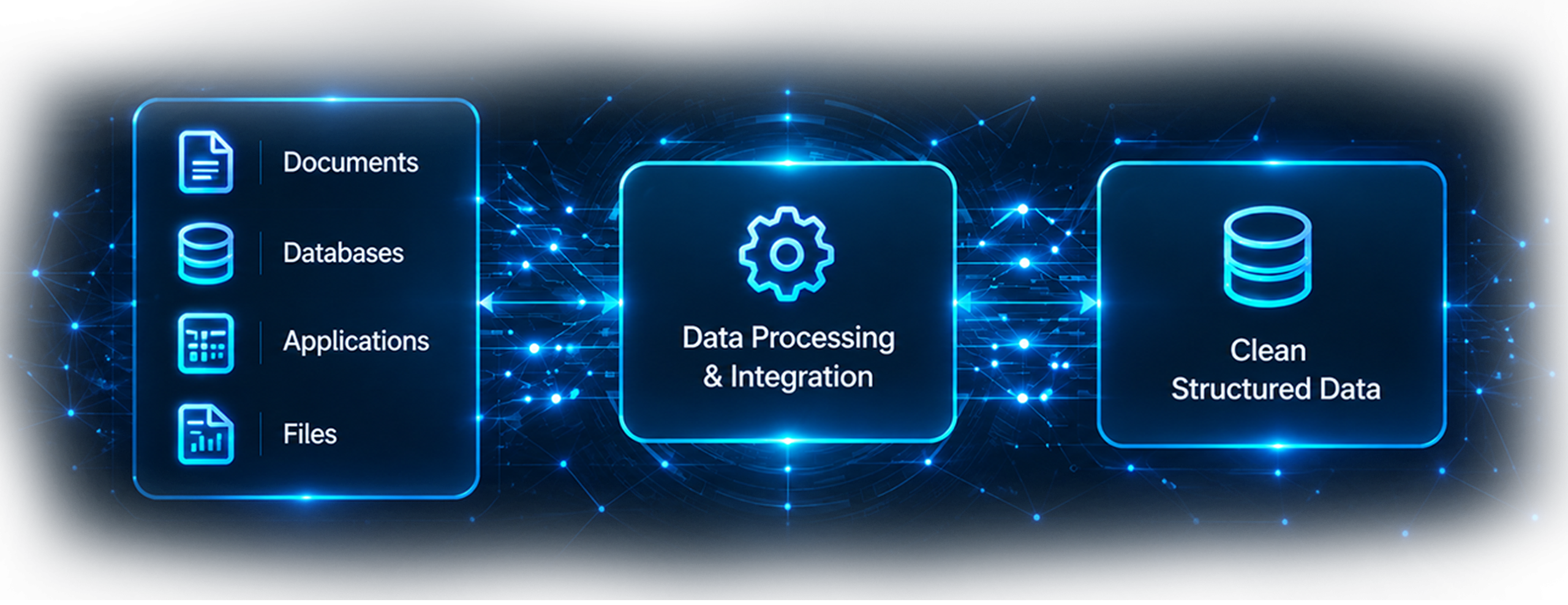
Data preparation and integration
Connect, clean, map and organise information from the systems required by the use case.
Business questions
this can help address
What relevant knowledge already exists within our documents and records?
Which historical projects, cases or customers are most comparable?
What patterns are visible across previously disconnected information?
Which records or events require human attention?
What may happen next if the historical data is suitable for modelling?
Which outstanding actions, risks or opportunities should management review?
How can staff retrieve answers without searching across multiple systems?
How can information move from analysis into an operational workflow?
Suitable
starting signals
AI and data intelligence may be worth exploring when the organisation has accumulated meaningful information and a repeatable business question or decision.
- Years of business records, reports or project documents
- Repeated decisions based on historical information
- Important knowledge distributed across multiple people or repositories
- Staff repeatedly searching or reconciling the same material
- Management reporting assembled manually from several systems
- A forecasting, prioritisation or comparison problem with a clear business action
- A workflow in which better information could change what happens next
How WSM
approaches the work
WSM starts with the decision, workflow or outcome that needs to improve rather than with a predetermined model or platform. We then assess the available information, define the required controls and build the smallest useful intelligence workflow that can be properly tested.
01
Clarify the business question and the decision that follows.
02
Identify the users, systems, documents and data involved.
03
Assess data quality, relevance, permissions and feasibility.
04
Define the output, governance and acceptance criteria.
05
Build the required data, intelligence and interface components.
06
Validate with users and representative or historical information.
07
Integrate the capability into the operational workflow
08
Monitor, improve and extend only where the evidence supports it.
Responsible implementation
AI outputs should be treated according to their purpose and consequence. A retrieved source passage, a generated summary,
a predictive score and an automated customer action do not carry the same risk and should not be governed in the same way.
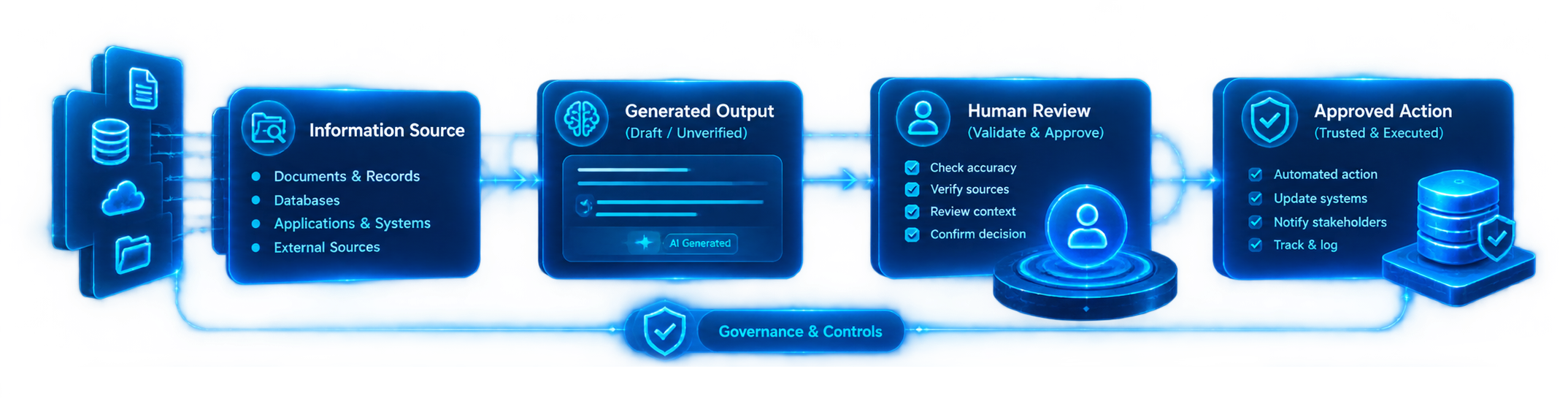
Role-based access to approved information
Source references where grounded retrieval is required
Clear distinction between facts, generated summaries and model outputs
Human approval for consequential decisions and external commitments
Testing against agreed business and technical criteria
Logging and monitoring appropriate to the workflow
Secure handling of business and personal information
Defined behaviour when information is missing, conflicting or uncertain
From information
to action
The final interface may be a search experience, management dashboard, workflow screen, alert, API or embedded feature within an existing portal. The objective is not simply to generate an answer, but to make approved information useful at the point where work or a decision takes place.
natural-language query
What are the top risk in our current projects?
Base in our data, the top risks are:
- Resources Delay
- Budget Variance
- Vendor Dependency
management dashboard
Project Performance
On Tracks
12 Projects
At Risks
4 Projects
operational alert
Attention Needed
Explore a defined AI and
data opportunity
Bring a real business question, examples of the current process and representative information. WSM can help determine whether knowledge retrieval, analytics, prediction, automation or a custom system is the appropriate starting point.